
Description
About the Artist:
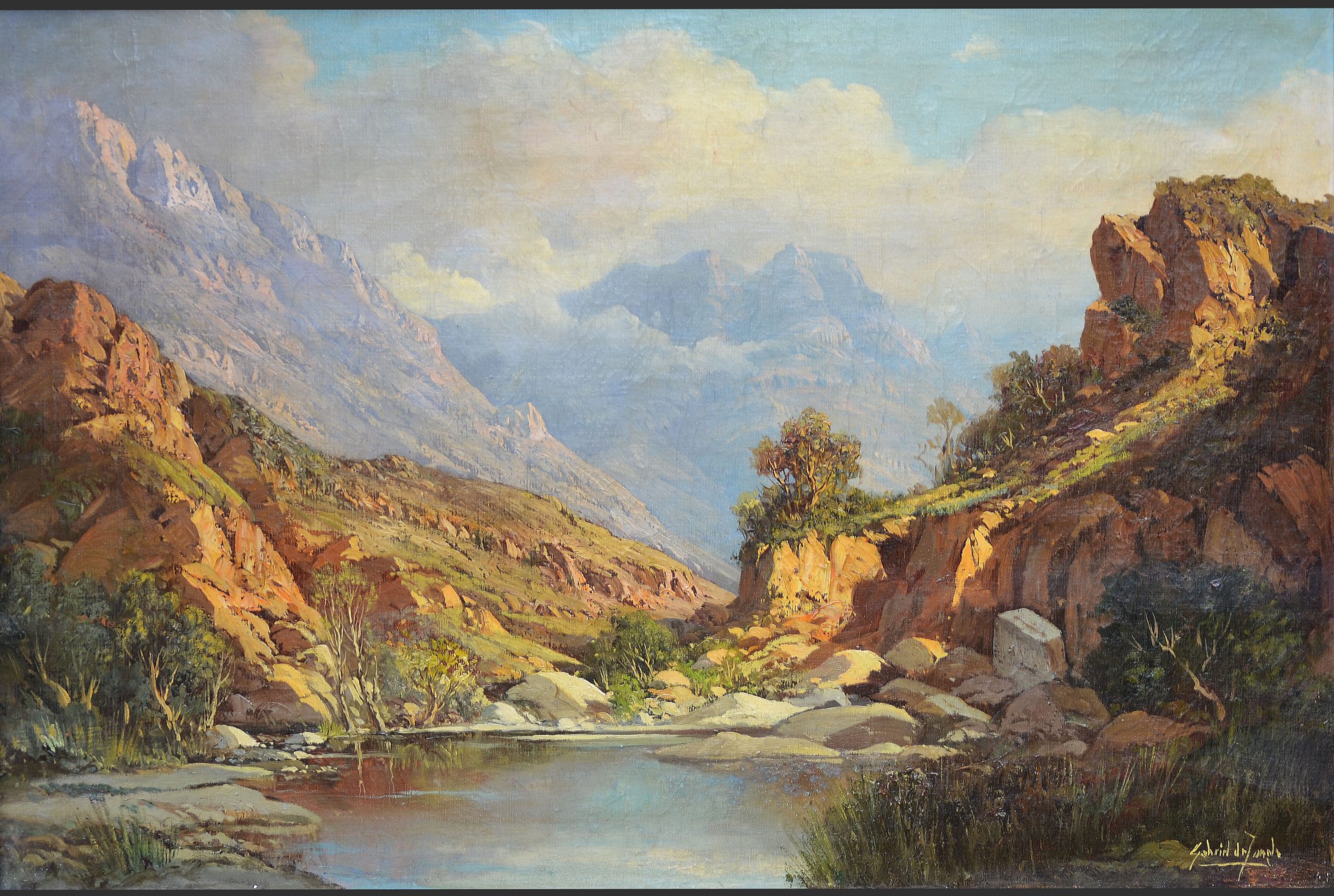
Gabriel de Jongh worked in oil, watercolour, ink and pencil. Painting landscapes, still lifes, seascapes, wildlife and depicted religious themes. His works are to be seen in public and private collections all over the world.
Gabriel, a Dutch-born South African artist, moved to Cape Town with his family at the age of nine in 1922. The family initially settled in Fishhoek, which provided an ideal location for exploring the Cape Peninsula with his father, Tinus, a well-known landscape artist. After completing high school in 1930, de Jongh spent a year being tutored by his father in watercolour techniques before starting an apprenticeship at The Cape Times. He also pursued part-time studies at a technical college for special techniques and at the University of Cape Town’s Michaelis School of Fine Art for woodcarving under HV Meyerowitz.
In 1937, his father invited him to exhibit some artwork alongside his own in an exhibition at the Riviera Hotel in Hermanus; his twenty watercolours sold within the first day. This success led to his participation in various South African art society exhibitions. During World War II, he served in the Civil Defence Corps until 1942, when he was called for service by the Dutch Government. Despite his service commitments, de Jongh continued to paint and draw in his free time and was even able to attend classes part-time at the Slade School of Art in the UK.
After being medically discharged, he returned to South Africa in June of 1945 and resumed his position at The Cape Times. Following the war, he shifted his medium to oil painting. De Jongh travelled extensively and visited Europe, South America, and East Africa, but his favourite subject remained the landscapes of the Western Cape.